Ornamental flowers that brighten our gardens could be quietly harming butterflies in ways scientists are only beginning to understand, according to a new study.
Lush gardens full of vibrant flowers are a delight, fueling an ever-increasing demand for blooms in bold, vibrant colors to fill our gardens with. Commercial nurseries, happy to comply, keep creating new cultivars and importing new, exotic plants from other regions to keep customers happy.
But those beautiful flowers are not always innocuous in their new homes. They sometimes escape into natural areas and, with no natural enemies to control their spread, aggressive species can overwhelm native habitats, crowding out native species and upsetting the natural balance that has evolved over eons with local wildlife and other plants.
Now a new study shows that escaped plants can have even more insidious impacts than previously realized, disrupting the mating success of local butterflies in unexpected ways that biologists are just now beginning to understand.
If you’d like to get new posts sent directly to your inbox every week, subscribe to my newsletter via Substack:
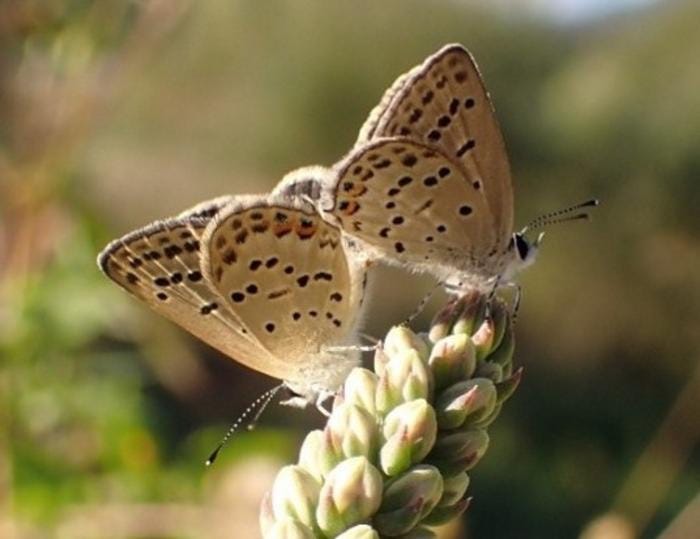
Non-native plants can have sneaky effects on local insects.
The groundbreaking study, published in the journal Basic and Applied Ecology, demonstrated that non-native plants escaped from cultivation in Japan can have sneaky effects on a rare butterfly’s attractiveness to potential mates, quietly disrupting its mating behavior and, potentially, its ability to produce enough young to survive over the long term.
“These findings can serve as a model case that highlights the indirect threats posed by invasive plants to herbivorous insects,” said Norio Hirai, the senior author of the study and a professor at Osaka Metropolitan University, in a statement.
This creates an unexpected threat to the butterfly’s ability to reproduce successfully that was previously unknown and could prove particularly devastating to rare insects already threatened by habitat loss, pesticide use and climate change.
Fischer’s blue (Tongeia fischeri) is a yellowish butterfly with a series of black and black-orange dots on its wings. It ranges from the Ural Mountains in Russia east to China, Korea and into Japan but is declining, listed as “near threatened” in Japan.
The caterpillars of the small butterfly – it has a wingspan of around 2.5 cm, about an inch – mainly feed on the plant Japanese dunce cap (Orostachys japonica), a native succulent plant that occurs in rocky habitats in mountains, riverbanks and coasts. The plant’s habitat is declining, however, and it’s listed as near threatened in Japan.
Butterflies are feeding on invasives as their native host plants decline.
The Fischer’s blue is nothing if not adaptable. With the decline of its favorite host plant, the insect has branched out to lay its eggs on other succulents, such as stonecrops in the Sedum genus.
These plants, however, are not native to Japan, especially the stringy stonecrop (Sedum sarmentosum), an aggressive Chinese succulent that is cultivated and naturalized in Japan, North America and Europe. It’s considered an invasive in many countries, actively displacing native plants.
So, while the butterfly’s ability to feed on plants other than its preferred but declining host plant could be interpreted as a welcome sign that it’s expanding its diet in response to the changing plant diversity around it, there are signs that all is not well.
Biologists had noticed that the undersides of the wings of Fischer’s blue butterflies whose caterpillars had fed on the invasive stringy stonecrop looked different from those raised on the native plant, appearing grayer.
But no official studies had been done to confirm the difference or what, if any, consequences there might be.
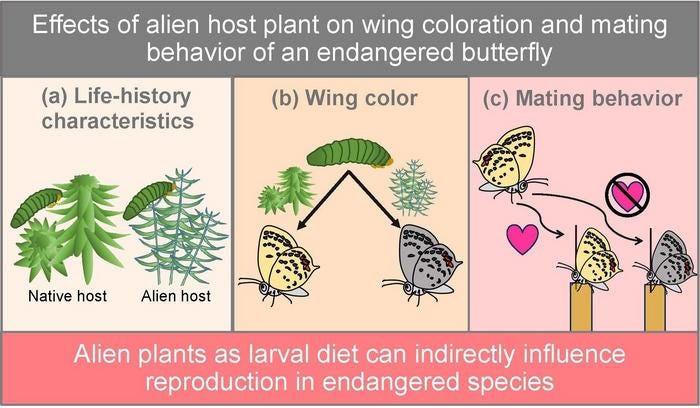
Analyzing potential effects when caterpillars change host plants.
That’s when Hirai’s team decided to investigate the relationship between the caterpillars’ host plant, the resultant wing colors of adult butterflies and how potential mates might react.
In butterflies, the attractiveness to potential mates depends on several factors, including its wing colors – what scientists measure as “spectral reflectance,” meaning the exact light wavelengths that are bounced back by a butterfly’s wings – and the sex pheromones released by the insect.
The researchers analyzed several factors that could be affected by changes to the caterpillars’ host plant. They examined whether wild-caught females deposited more eggs on either the native Japanese dunce cap or the invasive stringy stonecrop, any changes in caterpillar growth, how the wing colors of adult butterflies reared on each plant differed and how other butterflies reacted to individuals raised on each of the two plants.
The results were subtle but concerning.
The biologists detected no preference in the females’ choice of plant to deposit their eggs on, or in the resultant caterpillars’ weight or growth.
However, in human-visible light, the wings of native plant-reared butterflies appeared more yellowish than their counterparts raised on the non-natives, which were grayer.
Since butterflies see more wavelengths than humans do, the research team also examined the wings’ reflectance in the ultraviolet light range.
And those results showed that the ultraviolet reflectance was significantly lower in butterflies raised on the invasive plant, meaning that to other butterflies, individuals raised on the invasive plant would look very different from those raised on the natives.
The scientists then tested how wild male butterflies responded to the differences.
Male Fischer’s blue butterflies prefer native-plant-reared females.
These results were the most surprising – male butterflies contacted females raised on native plants significantly more often than females raised on invasives, indicating a clear preference for native-plant-raised females.
Karen Hisai, the study’s first author, said in a statement, “This study provides a rare example in Japan demonstrating that even when invasive plants can be used as food, they may indirectly influence the reproductive process.”
The results are concerning for butterflies that are dependent on native plants that are declining, even if the insects can adapt to feed on non-natives. The switch in caterpillar food could lead to subtle differences in the adult butterflies that are obvious to other butterflies but not to us.
What does it mean for conservation?
We often don’t understand enough about the ecology of insects to be able to predict the repercussions of an unfamiliar diet on a species’ mating behaviors and how that might affect the resulting reproduction success.
But the potential consequences on rare species are alarming.
Hisai said, “as the number of invasive species continues to increase, similar effects may potentially occur in other butterfly species and insects.”
And that could ultimately make all the difference to a butterfly already stressed by other human-caused changes to its world.
If you’d like to get new posts sent directly to your inbox every week, subscribe to my newsletter via Substack:
It’s free to subscribe, but if you choose the paid option you’d support my work and help keep my articles free for those who can’t afford a paid subscription!
Not ready to subscribe? It takes many hours to research and write each post, so please consider supporting my work by buying me a coffee (or a beer…😄).
Links to resources:
- Hisai et al., 2026, Effects of alien host plant on wing coloration and mating behavior of an endangered butterfly. Basic and Applied Ecology, 92:13-19.
- Shackleton et al., 2022. Consensus and controversy in the discipline of invasion science. In Conservation Biology, 36(5):e13931.
- Jeratthitikul et al., 2013. Phylogeography of Fischer’s blue, Tongeia fischeri, in Japan: Evidence for introgressive hybridization. Molecular Phylogenetics and Evolution, 66(1):316-26.