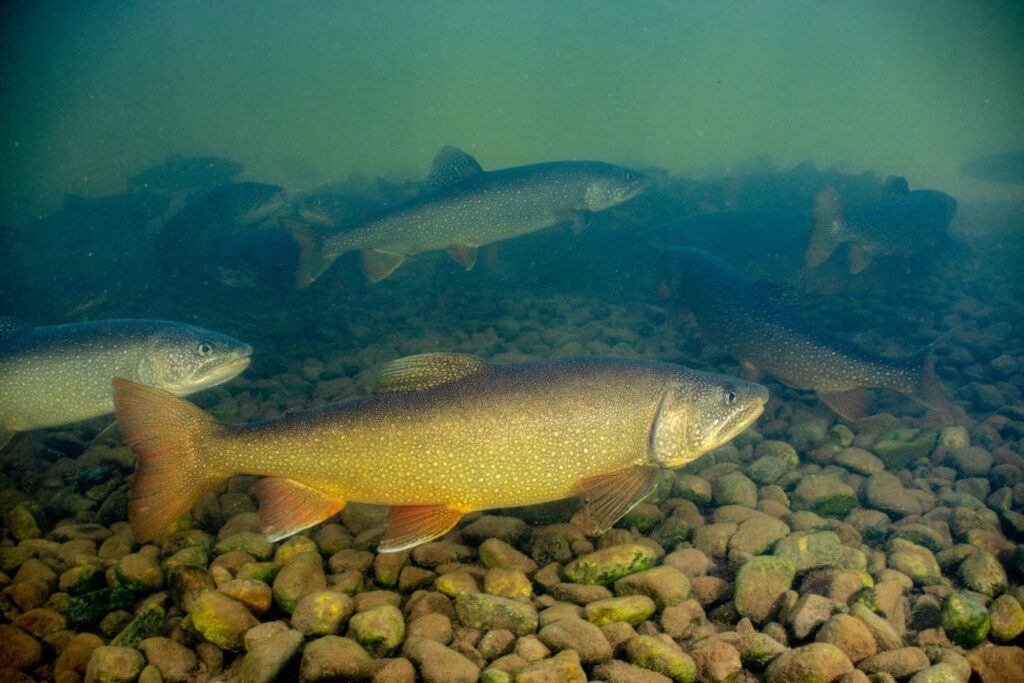
Researchers found toxic PFAS chemicals in every fish tested in two Michigan watersheds, with highest levels in organs and eggs that pose risks to animals that eat entire fish.
PFAS chemicals – also called “forever chemicals” because of their longevity in the environment – have been implicated in many human health problems, including cancer.
But it turns out that they’re not only dangerous to human health. Because wildlife often eat all parts of a fish, including organs, they could be exposed to the hazardous chemicals at even higher levels than people.
Companies are still adding PFAS to thousands of consumer products all over the world despite not knowing how safe most of them are for people or the environment, even as more and more contaminated sites are identified.
Here’s a story I wrote last year, updated and lightly edited, about a study that found alarming levels of forever chemicals in Michigan fish. But it’s not hopeless – I also talked to the scientists working hard to find solutions, assess just how dangerous each of the thousands of PFAS are and ultimately reduce our exposure to these chemicals. Meanwhile, more states are enacting bills to limit the chemicals’ use in products, especially where safer alternatives are readily available.
If you’d like to get new posts sent directly to your inbox every week, subscribe to my newsletter via Substack:

PFAS contamination found in every fish studied
Every fish studied in two southeast Michigan watersheds contained at least one of a family of toxic and persistent health-threatening chemicals.
The chemicals – collectively known as per- and polyfluoroalkyl substances or PFAS – are found in some rivers, lakes, soils, drinking water, fish, cattle and crops. The study by researchers at Indiana University and the Ecology Center in Ann Arbor measured the contamination of fish in Michigan’s Huron and Rouge River watersheds.
The findings are sobering. “Every fish had at least one” of the 14 PFAS chemicals examined in the study, Erica Bloom, toxics campaign director at the Ecology Center, told me.
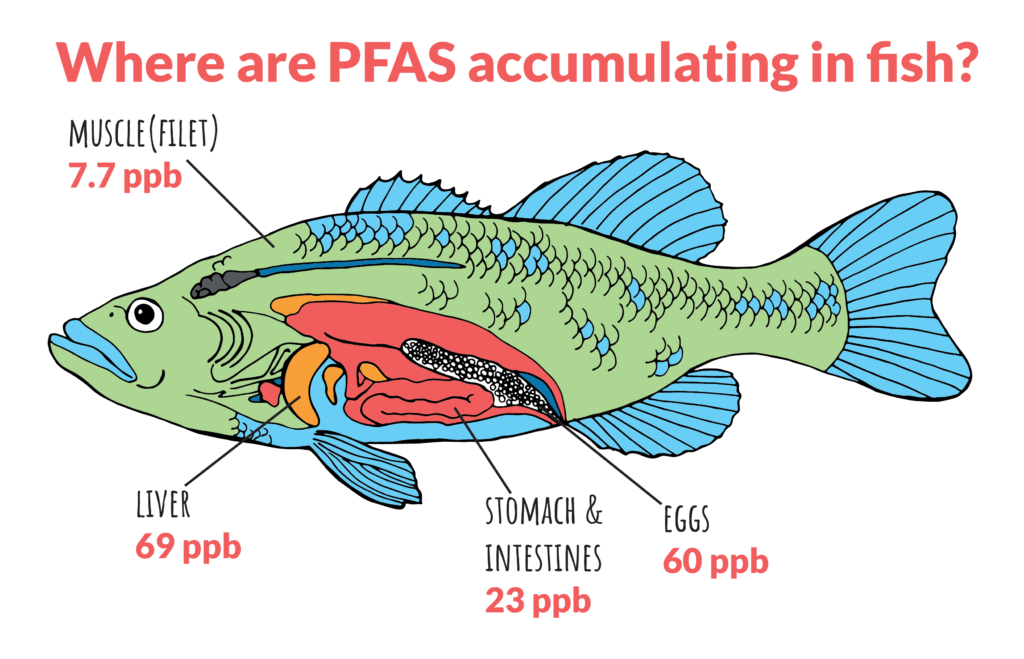
The study, published in the journal Chemosphere, looked not only at the amount of PFAS in the filets that people eat, but also in the liver, eggs and digestive tract to assess potential effects on wildlife that eat entire fish.
Levels they found in the filets were much lower than in other parts of the fish, especially the liver and eggs, which had the highest levels, Gillian Miller, a senior scientist at the Ecology Center, told me.
The results are “not so good for animals, which eat the fish whole,” Miller said.
Even the PFAS amounts in the filets were concerning. The study found that if people eat fish caught in the tested rivers daily they would exceed Michigan’s Eat Safe Fish recommendations.
In the Huron River the tested filets had particularly high PFAS levels. The Michigan Department of Health and Human Services has issued a Do Not Eat advisory for much of the Huron River, which means that even one meal of these fish could lead to health problems.
PFAS are all human-made and still used in many consumer products
And little is known about many more PFAS chemicals that have been manufactured since the 1940s. Only two – known as PFOS and PFOA – have been extensively studied. Michigan’s Eat Safe Fish guidelines account for only PFOS – and not the many other PFAS chemicals that may also be present.
High levels of these chemicals have been implicated in multiple health problems in humans, including thyroid disease, kidney and testicular cancers, increased cholesterol, liver damage, decreased immune system response to vaccinations and others, according to the Environmental Protection Agency.
The health threats of most of the other more than 10,000 PFAS chemicals are poorly understood.
“There’s a lot we don’t know” about PFAS and their effects, Cheryl Murphy, director of the Center for PFAS Research at Michigan State University, told me.
“We are starting to get a handle on a little bit of it, but there’s still lots to do.”

Only a handful of PFAS are regulated
Michigan regulates only seven of the thousands of PFAS chemicals in drinking water. At the federal level, the EPA regulates six PFAS chemicals and has set a limit of four parts per trillion for two of them. That is the lowest level that testing methods can pick up.
“Basically they’re saying that we shouldn’t be able to detect them,” Murphy said.
Gary Ankley, a toxicologist at the EPA, told me that “in terms of visibility and emphasis [PFAS is] probably the most significant group of chemicals the EPA’s ever focused on in terms of effort and interest.”
PFAS chemicals are used in a plethora of products such as firefighting foams, chrome plating and electronics manufacturing facilities, and many consumer products, including stain- and water repellent products, non-stick cookware, food packaging and some personal care products.
“Most of us get [PFAS] through our diet,” Murphy said.
Sources of the chemicals that can end up in people include drinking water, fish, wildlife, food grown on contaminated soils and packaging that touches food.
“A lot of these chemicals will disrupt the normal hormonal processes, the physiological process within an organism in subtle ways,” Murphy said. “You don’t see a huge effect immediately. The effects usually show up after years of chronic exposure.”

How scientists are studying the ‘forever chemicals’
It is difficult to study so many chemicals but researchers say they are making progress in doing it more quickly.
“It took us 30 years to figure out the toxicity of these two chemicals,” Murphy said. “There are over 10,000 of these chemicals and we have no idea about most of them.”
It can’t take another 30 years to find out, she said. “We have to adopt new approaches.”
To study the safety of so many potentially harmful chemicals, the EPA has been exploring a high-tech method called the Toxicity Forecaster, or ToxCast. It is adapted from the pharmaceutical industry’s methods for testing drugs before performing expensive clinical trials.
PFAS is the perfect test for this new method because it’s such a large group of chemicals, Murphy said. It also allows scientists to study mixtures of chemicals more efficiently, which more closely resembles how humans are exposed.
“It’s pretty science-fiction-like but at its core it’s pretty simple,” Ankley said. Instead of testing chemicals on whole animals or plants, researchers study the chemicals’ impact on cells and tissues.
These tissues are maintained in the lab for months or years and can be exposed to hundreds or even thousands of chemicals through a high volume system using robotics.
“The responses can be measured in an automated fashion,” Ankley explained. “So you can get insights pretty quickly and efficiently.”
A more thorough analysis is then prioritized for the chemicals that show negative effects at low concentrations.
“To do a full risk assessment, you have to take those data and put them in the context of a whole person or a whole fish or a whole deer,” Ankley said.
Growing awareness of the problem can lead to reducing our exposure
Despite many challenges, given the recent scientific advances and public awareness around PFAS, Ankley and Murphy are optimistic that solutions will be found to reduce exposure to them.
“I have a feeling we’ll be dealing with PFAS, trying to figure things out, for at least a decade,” Murphy said.
Promising recent developments such as filters to remove PFAS from drinking water could mean “that in five or 10 years we’ll have a good handle on how to reduce our exposure to it.”
Ankley agrees: “Frankly, I wouldn’t be working in [this field] if I thought there was no way to address these challenges. But we do have new technologies, things like ToxCast, that enable us to look at chemicals in ways that we haven’t been able to do as efficiently in the past.”
This article previously appeared in Michigan State University’s Great Lakes Echo under the title “High levels of toxic forever chemicals in Michigan fish alarm scientists.”
Links to resources:
- Capozzi et al., 2023: From watersheds to dinner plates: Evaluating PFAS exposure through fish consumption in Southeast Michigan. Chemosphere, 345:140454.
- U.S. Environmental Protection Agency Toxicity Forecasting: ToxCast
- National Institute of Environmental Health Sciences: Perfluoroalkyl and polyfluoroalkyl substances (PFAS).
- European Food Safety Authority: Per- and polyfluoroalkyl substances (PFAS).
- U.S. Environmental Protection Agency: PFAS explained.
- Michigan State University Center for PFAS Research.
- Michigan PFAS in Drinking Water Rules
- Michigan Eat Safe Fish Guides
All essays are free for everyone to read and subscribing is free. But if you can afford it, please consider a paid subscription or a one-time donation to help me continue researching, talking to experts and writing!
Or: