By raising hatchlings in captivity through their first winter, researchers hope more threatened turtles survive to adulthood.
Years ago, when I worked for the Minnesota Department of Natural Resources, I had the pleasure of working with rare Blanding’s turtles, using telemetry to track them to learn more about their life cycles and how they used local habitats.
I’ve been in love with turtles ever since, so when I was asked to report on a local zoo’s efforts to protect another rare turtle species – the charismatic yet secretive spotted turtle – I was excited to say yes.
This is a neat story about a pilot program to learn whether raising hatchlings in captivity could be a way to bolster local populations of the threatened turtle, while also teaching students what it takes to care for protected species.
The article I wrote for WKTV Journal can be found here. I had to keep that story fairly short, so could go into more depth here.
If you’d like to get new posts sent directly to your inbox every week, subscribe to my newsletter via Substack:
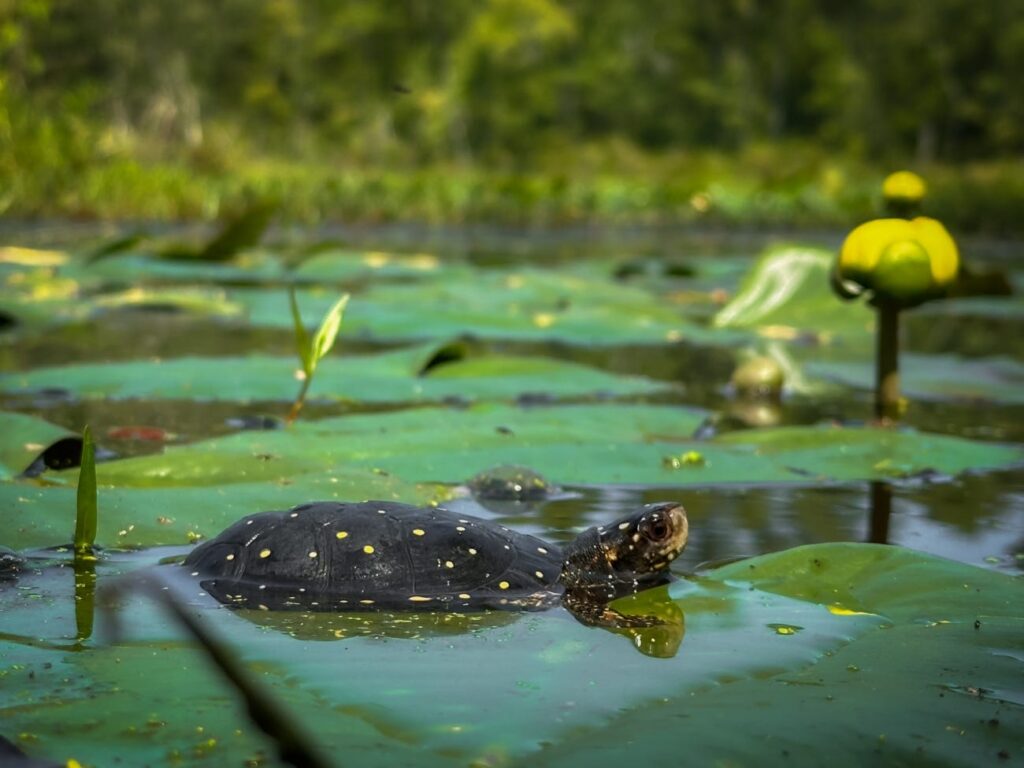
One of Michigan’s rarest turtles is getting a boost in early survival thanks to a program called ‘headstarting,’ where biologists collect eggs, hatch them in captivity, and raise the babies through the winter. The young turtles are then released back into the wild in the spring.
Spotted turtle eggs and hatchlings are particularly vulnerable to predators like raccoons, Bill Flanagan, conservation director at John Ball Zoo in Grand Rapids, Michigan, told me. The secretive turtles are listed as threatened in Michigan and categorized as ‘endangered’ by the International Union for Conservation of Nature.
“Raccoons are very efficient predators of turtles. They’re really good at finding the nest, they’re really good at finding the little guys,” he said. And because raccoons do well around humans, their populations have skyrocketed in recent years.
That’s why the zoo teamed up with Calvin University to test if headstarting, which has been successfully done with other turtles like the rare eastern box turtle, will lead to more spotted turtles surviving to adulthood.
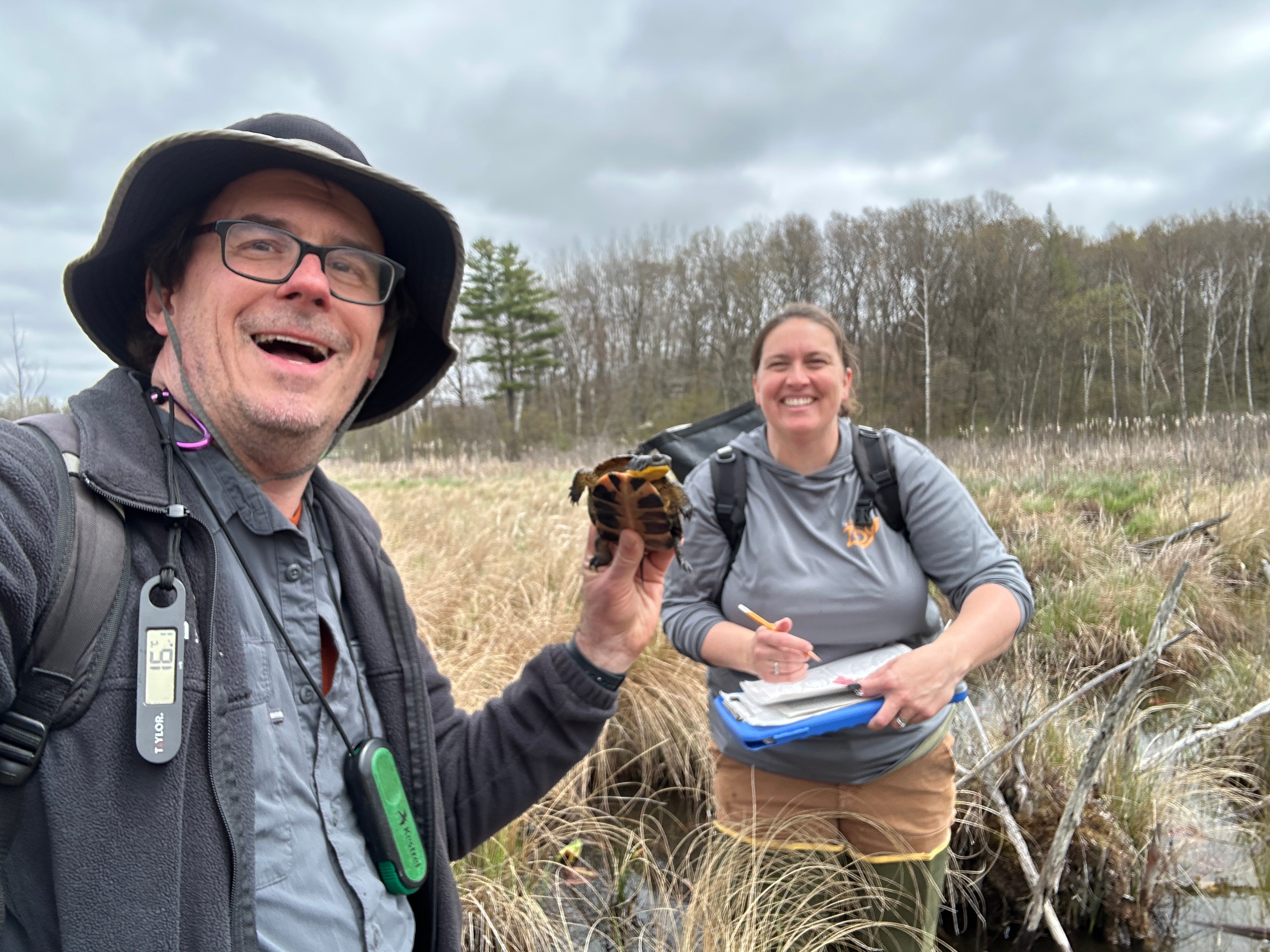
Testing if headstarting might help spotted turtles
“The idea is that we can grow a larger baby turtle that’s more robust to some of these challenges that they will meet in their native environment,” Will Miller, associate professor of biology at Calvin University, told me.
Many nests and juvenile turtles never make it to adulthood, which can then compound other issues like habitat destruction, as well as poaching for the pet trade, he added.
Zoo researchers gathered 15 eggs from spotted turtle females in the wild last fall and divided them into two cohorts, Flanagan said.
One group was released into the wild immediately after hatching. Hatchlings in the other group were raised in captivity and released this spring. Both groups are tracked by zoo staff using telemetry to ultimately compare the outcomes between the groups.
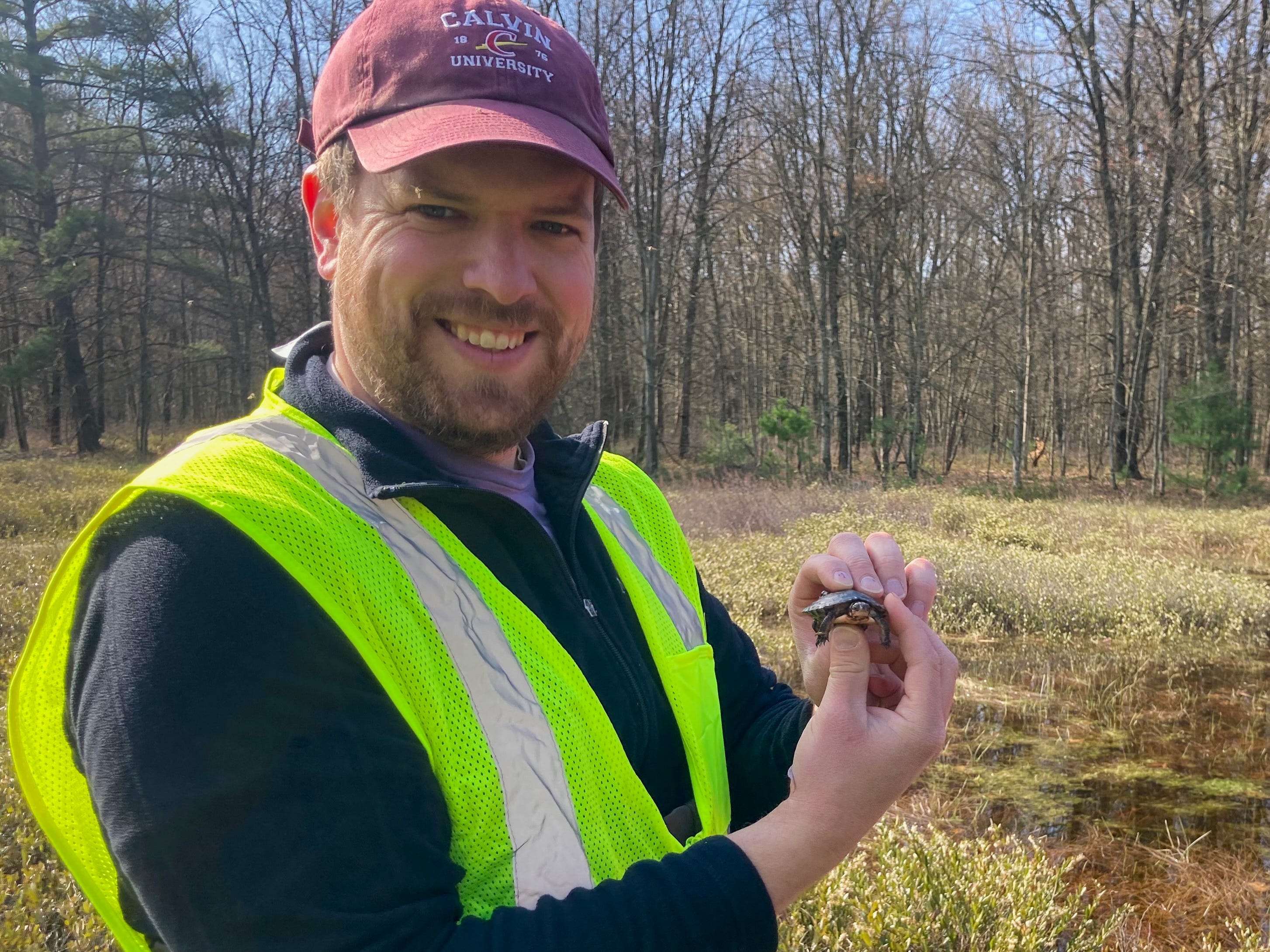
Combining conservation and educating the next generation of biologists
While zoo biologists were responsible for the fieldwork, Calvin University students, with help from faculty and zoo staff, cared for the baby turtles once they hatched.
It was a rare opportunity for students to gain hands-on experience raising rare turtles. The animals were fed a nutrient-dense diet to fatten them up as quickly as possible and needed daily care, so students had to come in on weekends and during holiday breaks.
“We saw this as a major win-win, both from an educational and a conservation research standpoint,” Miller said. “The students absolutely loved being part of this project.”
It’s too early to know just how much of a growth advantage the turtles get after spending a winter gorging on plentiful food compared to their wild brethren and sistren, but Flanagan said box turtles in headstarting programs grew to the size of a typical three- or four-year-old turtle in just 10 months.
And that size difference could mean the difference between life and death for young turtles.
Flanagan said the project will continue for at least another season to get as much data as possible on how the animals do. He’s also hoping to find more nesting females.
“We’re really keyed in on trying to learn more about the nesting ecology for spotted turtles,” he said. “This is a species that we don’t know a ton about how they nest, especially here in Michigan.”
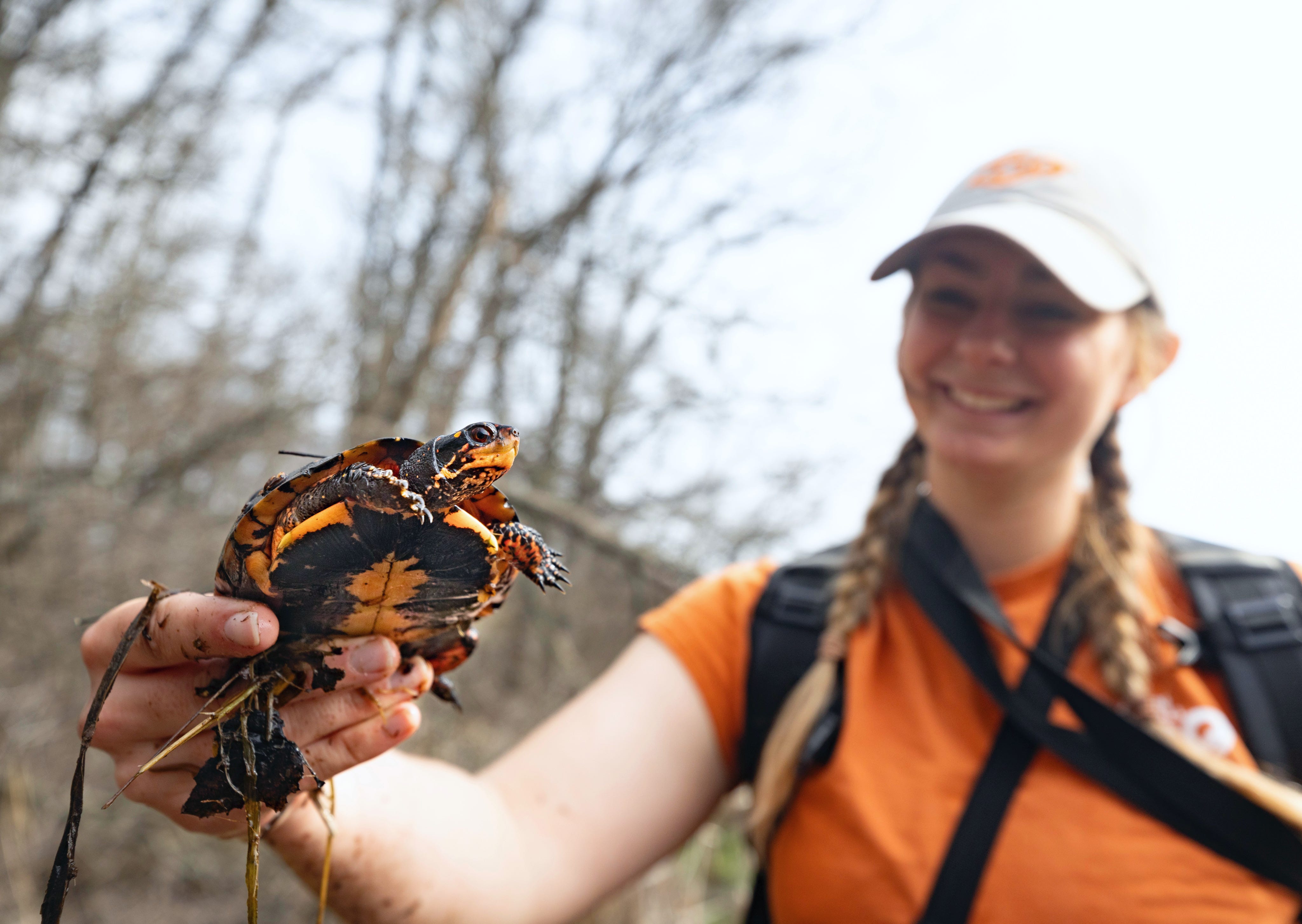
Spotted turtles’ reclusive habits make them difficult to study
Spotted turtles are among the smaller turtles in the world – adults grow up to just over 5 inches long (around 14 cm), about the size of an index card. They also spend time in shallow wetlands away from humans, Dan Earl, a zoology research assistant with the Michigan Natural Features Inventory, told me.
“They’re pretty reclusive as far as our turtle species go,” he said. “They tend to not be as mobile as some of our other turtles, and they also have a very short active season.”
Spotted turtles start moving early in the spring and are fairly cold-tolerant. “But when you get past June, they kind of hunker down for the year,” Earl added. “They’re just hard to find.”
Because they don’t reproduce until they’re 10 to 15 years old and the young have a high mortality rate, it’s especially important that adults survive as long as possible.
But more adult turtles are dying because of humans, including getting hit by cars and through habitat loss.
Aquatic species like the spotted turtle are dependent on wetlands, but that habitat type has declined dramatically in past centuries. By United Nations estimates, more than 85% of wetlands were lost worldwide between 1700 and 2000. In Michigan, nearly 40% of wetlands had disappeared by 2005.
And more wetlands are disappearing every year. For species that aren’t very mobile, like turtles, that’s a problem.
“They’re not going to be able to get up and move miles over farm fields and roads to get to a new pocket of habitat, they kind of have to hold on to where they are,” Earl said.
Dangers from the illegal pet trade
Additionally, spotted turtles are among the most charismatic local turtles, and their small size makes them highly desirable for the illegal pet trade.
“Their superpower, which is to be super cute, may also sometimes be their greatest detriment,” Miller said.
Flanagan described incidences where entire turtle populations were virtually wiped out in just a few weekends of collection.
“Collectors going in there and taking out the adults in the spring when the turtles are all out basking, and it’s easy to get a hold of a significant portion of the reproductive adults,” he added.
Biologists therefore need to keep locations where they find or release the rare turtles secret to avoid unscrupulous individuals getting word about where to find them.
Aging ‘ghost populations’ concern researchers
One worry when nesting success declines is what Earl calls “ghost populations.” That’s when adults persist at a site, but the population slowly dies out if no young turtles survive.
And since spotted turtles can live for more than 30 years, biologists may not realize what’s happening until it’s too late.
That’s why many biologists have such high hopes for headstarting programs. But, even if the initiative proves successful for spotted turtles, Earl warns that they won’t be out of the woods just yet.
“I would not rely on it as the sole way of saving the species,” he said. “If you’re just headstarting, you’re not addressing the root causes of why these populations are in decline. I think it’s going to be an excellent way to help them bounce back, but I think that’s going to go hand in hand with a lot of the other work.”
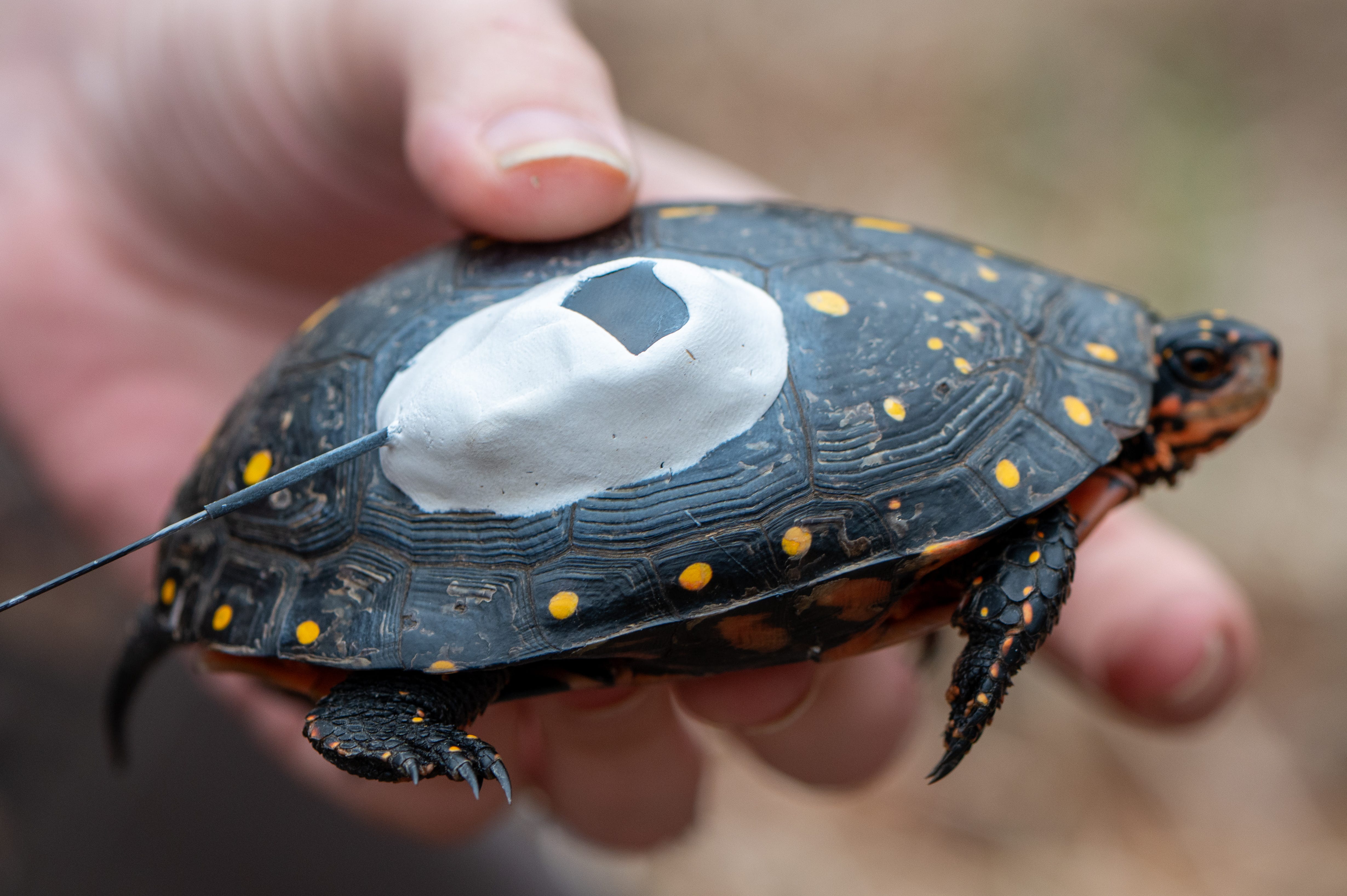
What you can do to help turtles
To help turtles, Flanagan encourages people to simply leave wild turtles where they are.
“One of the things we always say is, ‘If you care, leave it there.’ So, if you find a turtle in the wild, make sure that you leave it where it’s at,” he said. That’s because the animals are often moving for a reason, like to find a nest site.
But, if a turtle is on a road, it’s best to move it in the direction it’s going and not far from where it was found – as long as it’s safe for you to do so.
Additionally, “one of the really key things that people can do for nature is to get out and enjoy nature,” Flanagan added. And support local conservation organizations.
Miller encourages people to contribute to conservation efforts not only by donating money but to also get involved with citizen monitoring programs and learn about wetlands.
“They’re a critical and often endangered ecosystem type that our turtles rely upon, we rely upon for a variety of different ecosystem services,” Miller said. “Because what’s good for the turtle is good for us all.”
The loss of biodiversity isolates us, Miller said. “We draw connections to the world around us through our relationships with important animals and plants.”
He thinks we can also learn from turtles. “Sometimes we need a turtle to remind us that life is slow sometimes, and sometimes slowing down and doing things slowly provides immense value to people.”
If you’d like to get new posts sent directly to your inbox every week, subscribe to my newsletter via Substack:
It’s free to subscribe, but if you choose the paid option you’d support my work and help keep my articles free for those who can’t afford a paid subscription!
Not ready to subscribe? It takes many hours to research and write each post, so please consider supporting my work by buying me a coffee (or a beer…😄).
Resources & Links:
- IUCN Red List: Spotted Turtle
- IUCN Red List: Eastern Box Turtle
- International Convention on Wetlands: Global Wetland Outlook 2025
- United Nations Sustainable Development Goals Report
- Michigan EGLE: Status and Trends of Michigan’s Wetlands: Pre-European Settlement to 2005
- John Ball Zoo’s Great Lakes Rare Turtles Program
- Michigan Herp Atlas
- Turtle Survival Alliance
- Cornell Wildlife Health Lab: What the heck is herping?