2/25/2026: Costa Rican rainforests are thriving, climate safe havens for wildlife, Kyiv zoo struggles to keep animals warm, a flightless parrot breeds again, a push for whales’ rights, and more…
Welcome to a new edition of my weekly compilation of newsworthy stories about the state of biodiversity, the threats it faces and emerging solutions. My goal is to offer a snapshot of what’s happening in nature around the world and why it matters.
I found lots of neat biodiversity stories again this week, so decided to focus mostly on them. But there were also some important updates on the pollution side, so I included summaries of those so if you’re interested you can click on the links and read about what’s happening on that front.
If you’d like to get new posts sent directly to your inbox every week, subscribe to my newsletter via Substack:
So without further ado, scroll down to read about what’s new this week:
Biodiversity
- Rainforests in Costa Rica are growing back.
- Kashmiri farmers are restoring wetlands and adapting their crops in response to climate change.
- As the planet warms, climate safe havens provide refuges for wildlife.
- Kyiv zoo struggles to keep animals warm during the war.
- Rare New Zealand flightless parrot is ready for love after a bumper crop of berries.
- How did the eye evolve? It started with just one, studies suggest.
- An Indigenous-led push to recognize whales’ rights could change New Zealand laws.
Pollution & Pesticides
- Trump order seeks to protect herbicide embroiled in thousands of lawsuits.
- Pesticide use and cancer risk rise together in America’s heartland.
Biodiversity
Rainforests in Costa Rica are growing back
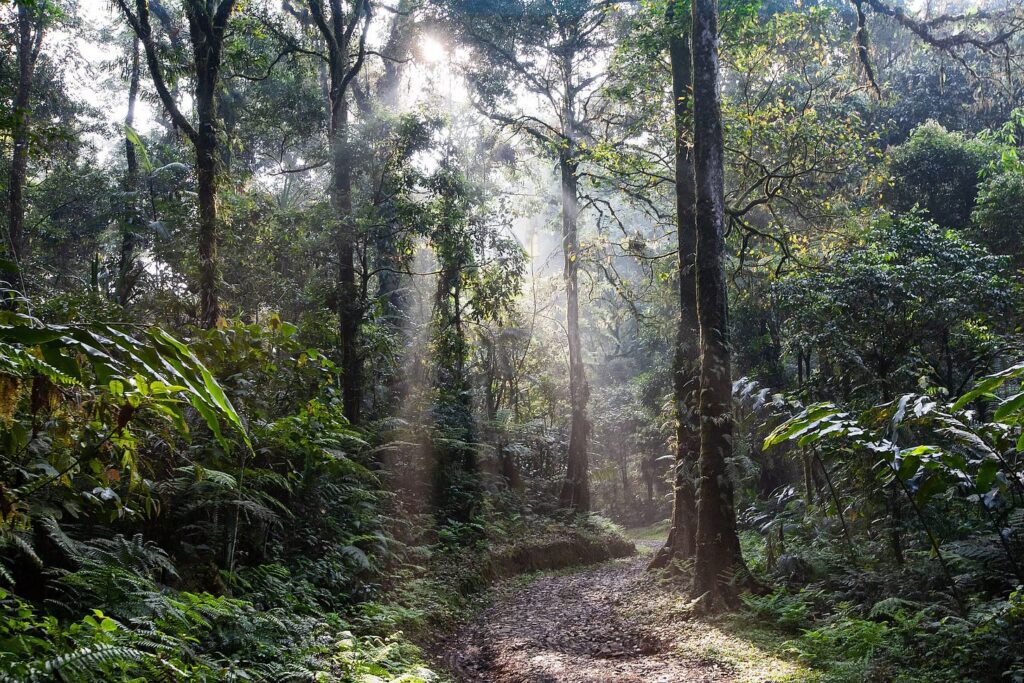
I’m happy to be able to start off with some good news – rainforests in Costa Rica are, actually, thriving, compared to most other countries where rainforests are logged at alarming rates, reports Benji Jones for Vox.
But that wasn’t always the case – deforestation in the country was once widespread. In 1985, “forests covered less than 25 percent of its area, down from closer to three-quarters just a few decades earlier,” Jones writes:
But then, near the start of the millennium, the trend abruptly flipped. Deforestation plummeted, and trees started growing back. Now, natural forests blanket well over half of Costa Rica, making it one of the few places on Earth that has revived its lost ecosystems.
So what happened here that isn’t happening elsewhere?
One oft-cited reason is that Costa Rica established a payment system for landowners to retain or restore forests, recognizing the significant “ecosystem services” intact forests provide:
Part of what made Costa Rica’s ecosystem payment program so groundbreaking is that it recognized — at the highest level of government — that living forests are not only a source of timber, but are economically valuable for lots of other reasons: they reduce greenhouse gases, produce clean water, draw tourists, and are home to plants and animals that scientists use for biology research and drug development.
But several studies indicate that the story is probably more complex, with lots of factors contributing, including that many Costa Ricans have a stronger environmental ethic than many other countries, and want to protect forests for their own sake.
So how can Costa Rica’s success be replicated elsewhere? Studies of payments for ecosystem services as an incentive to protect biodiversity in other areas have not yielded impressive results, disappointing advocates of those strategies. Jones writes:
But there is an important lesson here: No one solution, no one model, will solve a problem as difficult as deforestation. Costa Rica was successful because it had all of the right pieces in place — strong policies, favorable economics, growing non-extractive industries, and, perhaps most importantly, political will.
Kashmiri farmers are restoring wetlands and adapting their crops in response to climate change
Lotus stems once sustained local communities and families in Kashmir and beyond, but pollution and changes in weather patterns have caused them to nearly disappear in recent years, reports Safina Nabi for Reasons to be Cheerful:
Urban encroachment, sewage, rising temperatures and floods such as the disastrous ones that the region suffered in 2014 have clogged wetlands with debris and silt. Water levels have become erratic, aquatic life has declined and lotus cultivation has slowly faded. By the late 2010s, many families had stopped harvesting lotus altogether, turning away from the water that had long sustained them.
But grassroots efforts are bringing them back. Nabi writes about one farmer who spent months removing silt and waste from the waters of his former lotus plot, using methods he learned from his grandfather. Slowly, the murky, polluted water became clearer, then aquatic plants and small fish returned, and, finally, lotus stems grew again.
Other farmers’ fields, with crops that relied on dry soil at certain times of the year, were flooded because of climate change, drowning the harvest. But those farmers learned from their neighbors how to convert to lotus production. Nabi writes:
Nearby, Ghulam Mohammad Beigh’s family followed the same path. Their land, long considered unusable, produced lotus stem in its first season. Beigh’s wife, Haleema, now leads processing, frying nadur monji and preparing pickles for local markets. “When lotus disappeared, women lost work,” she says. “Now it’s coming back.”
While these individual efforts don’t replace the need for widespread wetland restoration, they are an important component to the overall system’s recovery as local communities work with the land, adapting to the changing landscape caused by humans.
As the planet warms, climate safe havens provide refuges for wildlife
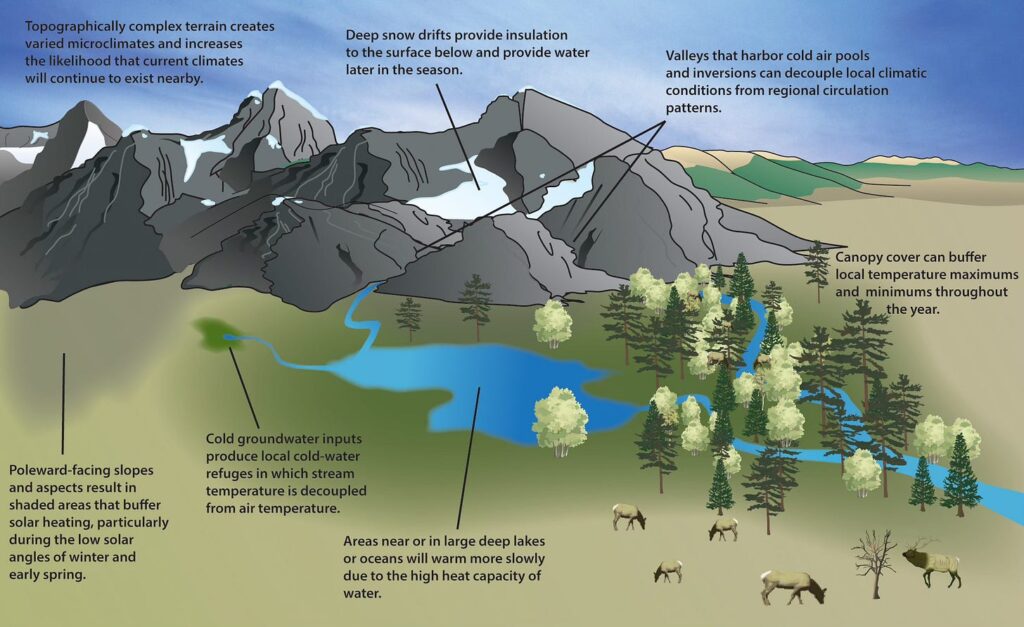
As climate change is causing temperatures in many areas to increase too quickly for animals and plants to adapt, researchers are studying so-called “climate refugia,”areas that naturally stay cooler thanks to shade or special topographical features, writeToni Lynn Morelli and Diana Stralberg for the Conversation:
By identifying and protecting the places where species can survive the longest, we can buy crucial decades for ecosystems while conservation efforts are underway and the world takes steps to slow climate change.
The article lists several examples: in California’s Sierra Nevada, Belding’s ground squirrels can thrive in certain shielded meadows and foothill yellow-legged frogs stay cool in shaded stream segments. More climate refugia are identified:
A new collection of scientific papers examines some of the most promising examples of climate change refugia conservation. In that collection, over 100 scientists from four continents explain how frogs, trees, ducks and lions stand to benefit when refugia in their habitats are identified and safeguarded.
These range from mapping sanctuary areas for songbirds in New England, moose and caribou in Canada’s forests and lions, giraffes and elephants in several African countries. Morelli and Stralberg write:
Across continents and climates, the message is the same: Amid our rapidly warming world, pockets of resilience remain for now. With careful science and strong partnerships, we can find climate change refugia, protect them and help the wild things continue to thrive.
Kyiv zoo struggles to keep animals warm during the war
Speaking of refugia, the 4-year-old war in Ukraine is causing hardships not only for the human population but also for zoo animals, reports Luke Harding for the Guardian.
As temperatures plunged to minus 22 degrees Celsius (around minus 8 degrees Fahrenheit) in recent weeks, zoo staff are struggling to provide animals, some of which originate in warm climates and are not adapted to the brutal cold, with the warmth they need.
Among them is Toni, a gorilla who needs a climate similar to the lowlands of central Africa. He’s also the zoo’s star attraction. Harding writes:
In recent weeks, heating Toni’s spacious enclosure has become a logistical headache. The zoo receives only three or four hours of regular electricity a day. Russian strikes have battered Ukraine’s energy infrastructure, leaving more than half a million people without power.
Toni shares a building with other animals dependent on warmth – “tortoises, lizards, a boa constrictor and a ginger cat that dozes by the entrance.” Staff tend to the animals around the clock:
To cope, the zoo has installed generators and wood-burning stoves. A large barrel-shaped convection heater, known as a Bullerjan, blows warm air into Toni’s enclosure, keeping it at about 17C. Staff feed the stove with logs gathered from the zoo’s 40-hectare (100 acres) grounds, even during midnight shifts. Additional stoves warm monkeys and exotic birds.
During blackouts, even the animals’ food is cooked on old-fashioned wood-burning stoves.
Rare New Zealand flightless parrot is ready for love after a bumper crop of berries
The reclusive and endangered kakapo, a bird native to New Zealand, has been slowly recovering from near-extinction. Now, an abundant harvest of its favorite fruit gives hope that this year, many kakapo will successfully raise young, reports Charlotte Graham-McLay for the Associated Press:
The world’s only flightless parrot species was once thought to be doomed by design. The kakapo is too heavy, too slow and, frankly, too delicious to survive around predators, and takes a shamelessly relaxed approach to reproduction.
Part of the problem is that kakapo only breed every few years – when the native rimu trees have bumper crops of fruit. Otherwise, “years or even decades can pass between successful clutches of eggs.” The birds, however, can live for 60 to 80 years.
New Zealanders have a special love for the bird, and have coaxed it back from the brink of extinction over the past three decades, increasing the population from just 50 individuals to more than 200.
Bird enthusiasts can even enjoy a “kakapo cam” of a nest with three eggs from 24-year-old Rakiura, an experienced mom. To ensure the survival of the eggs, researchers have replaced Rakiura’s eggs with fake ones to protect them from predators. The real eggs were placed in an incubator.
You can view the video here: Live kakapo cam.
How did the eye evolve? It started with just one, studies suggest
Among the most puzzling questions of evolution is how the eye developed in vertebrates – animals with a backbone. Now studies suggest our invertebrate ancestors 560 million years ago had only one eye at the top of their head, reports Carl Zimmer for the New York Times:
Charles Darwin fretted a lot about the exquisite complexity and sophistication of the vertebrate eye as he developed his theory of evolution. “The eye to this day gives me a cold shudder,” he confided to his friend, the American botanist Asa Gray, in 1860. Somehow evolution had produced the eye from many parts, such as the lens and retina, through tiny changes through the generations.
Opponents of evolution have long argued that the vertebrate eye is simply too complex to have evolved on its own. But other animals, such as invertebrates, have much simpler eyes, some “mere lumps of pigment that detect light.”
A new study proposes a series of steps that explain the evolution of the modern vertebrate eye, starting with an invertebrate ancestor with a single patch of light-sensitive cells on top of its head. It lived mostly buried on the ocean floor.
As its descendants started to swim and evolved into fish, their eye grew more complex, and eventually became two, which wandered to the sides of the head, enabling depth perception. At one point, some vertebrates evolved to have as many as four eyes – one each on the side of the head and a pair on top. Zimmer writes:
But as the new eyes migrated to their new positions, the animals still retained the ancestral eye on top of their heads. While it could not provide details about their surroundings, it continued to provide vital information, such as the overall level of light. Modern fish still have a light-sensitive patch of cells on top of their heads, known as the pineal gland.
Humans also have a pineal gland, but in mammals like us it is buried in the brain. It still responds to the time of day by releasing different hormones.
An Indigenous-led push to recognize whales’ rights could change New Zealand laws
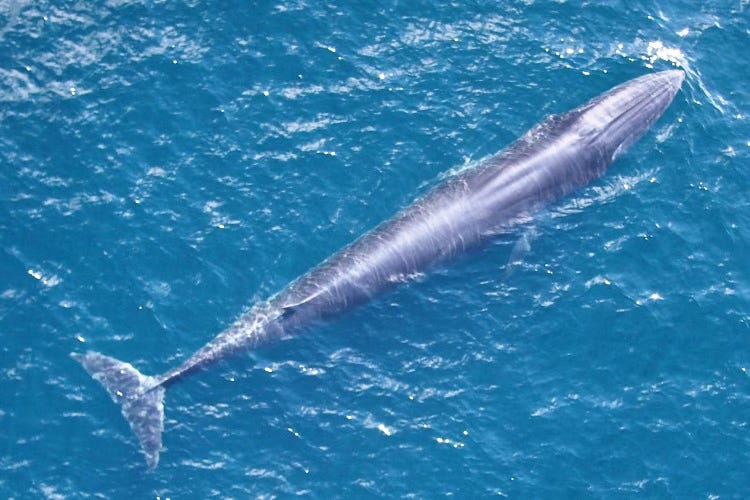
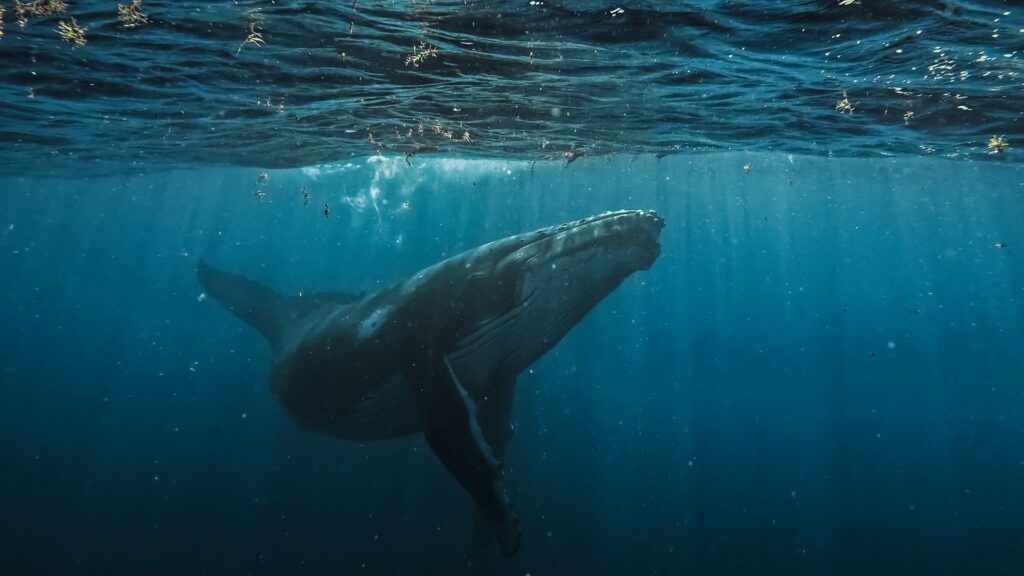
An effort started by the late Māori King Tūheitia Pōtatau Te Wherowhero to recognize the rights of whales could become law in New Zealand, reports Katie Surma for Inside Climate News:
New Zealand legislators this month introduced a bill … affirming whales’ rights to migrate, maintain natural behaviors and culture, and live in a healthy environment with damaged habitats restored.
The bill, introduced by a member of Parliament from the Green Party, Teanau Tuiono, would recognize whales as legal persons, a status already held by corporations and other nonhuman entities. The legislation would require the government to consider whales’ rights when regulating activities that affect them and their habitats, including shipping, fishing, deep-sea mining and coastal development.
The effort is spearheaded by Indigenous leadership, with legal and scientific arguments supporting their efforts. For example, the groups are evaluating research on whale communication to determine if it could support legal arguments for whales’ rights.
If the bill becomes law, it could unsettle industries that extract value from the ocean, Surma writes:
Still, the appetite for rights of nature laws is growing amid a wave of legal victories and worsening climate change, environmental degradation and species declines. Over the past two decades, hundreds of related laws, court rulings and declarations have emerged worldwide, many led by Indigenous peoples and organizations.
Pollution & Pesticides
This newsletter is already quite lengthy, so I’ll just provide short excerpts of other important pollution and pesticides news for the week:
Trump order seeks to protect herbicide embroiled in thousands of lawsuits
Carey Gillam reports for the Guardian:
Donald Trump has signed an executive order protecting production of glyphosate-based herbicides, such as Roundup, which some bodies and studieshave linked to cancer and which are the subject of widespread US litigation.
The president’s move, which also seeks to provide “immunity” for makers of the herbicides, was strongly criticized by health and environmental advocates including some figures in the “Make America healthy again” (Maha) coalition.
The order immediately provoked pushback, reports Rachel Frazin for the Hill:
At least one Republican lawmaker is formally pushing back on President Trump’s effort to boost a controversial herbicide, glyphosate, that’s reviled by supporters of the “Make America Healthy Again” (MAHA) movement.
Trump this week stoked MAHA fury by issuing an executive order that seeks to “ensure an adequate supply” of glyphosate as a national security issue and grant “immunity” to makers of the pesticide under the Defense Production Act.
In response, Rep. Thomas Massie (R-Ky.) drafted legislation to prevent the order’s implementation. Massie’s legislation also seeks to explicitly allow citizens to bring lawsuits related to exposure to glyphosate, the key ingredient in the frequently litigated Roundup weedkiller.
Pesticide use and cancer risk rise together across America’s heartland
Ben Felder reports for Investigate Midwest:
Increasingly, pesticides are being blamed for rising cancer rates across America’s agricultural communities.
Hardin County, home to around 800 farms, has a pesticide use rate more than four times the national average and a cancer rate among the highest in the state.
Most of the 500 counties with the highest pesticide use per square mile are located in the Midwest. Sixty percent of those counties also had cancer rates higher than the national average of 460 cases per 100,000 people, according to an analysis of data from both the U.S. Geological Survey and the National Cancer Institute.
And that’s it for this week’s State of Nature Update. I hope you enjoyed the stories! Drop a note in the comments if any resonated with you, or if there’s another biodiversity or other nature-related story you’d like to share with us!
If you’d like to get new posts sent directly to your inbox every week, subscribe to my newsletter via Substack:
It’s free to subscribe, but if you choose the paid option you’d support my work and help keep my articles free for those who can’t afford a paid subscription!
Not ready to subscribe? It takes many hours to research and write each post, so please consider supporting my work by buying me a coffee (or a beer…😄).