The world’s leading forest-certification system faces criticism, but evidence suggests it still makes a difference.

Prefer to listen to this post? Check out the podcast on Apple Podcasts or Spotify, or listen here:
I try to live in a way that is friendly to Earth – when I see options that are recycled or certified to come from sustainably managed forests, I usually grab them, even when they’re a little more expensive.
But are these products really better? Or am I rewarding companies for greenwashing?
When I saw a recent study about how animals are affected in forests certified by the Forest Stewardship Council (FSC) – generally regarded as the most rigorous forest certification label – I decided it was a great opportunity to learn more about the topic and separate the hype from facts.
I ended up going down a rabbit hole, reading various studies, reviews and critiques of the FSC. I discovered there are lots of strong opinions on both sides and that getting a solid scientific answer is incredibly complex and difficult.
Not surprising, really, if you consider that more than 430 million acres (around 175 million ha, about the size of Libya) of forest are certified under FSC in more than 80 countries as of 2026. In North America alone nearly 150 million acres are certified. That’s a lot of area to manage, inspect and certify with many local cultures and laws to navigate!
(Incidentally, that is down from more than 570 million acres (around 230 million ha – an area larger than Argentina) in 2022. After Russia’s invasion of Ukraine, FSC eventually withdrew from Russia, which had accounted for a large share of its European certified area.)
I feel like I just started scratching the surface, so I’ll be revisiting this topic again in the future. For now, I did come away with a decision on whether I’m willing to pay more for FSC-certified products. And I hope to bring you the information so you can do the same.
If you’d like to get new posts sent directly to your inbox every week, subscribe to my newsletter via Substack:
What is FSC-certified wood?
First – what does it mean to be FSC certified?
FSC is an international nonprofit organization that manages a voluntary forest certification standard. It was founded in 1994 for “sustainable forestry, promoting environmentally sound, socially beneficial and economically viable management of the world’s forests,” according to their website.
To be certified, forestry operators must adhere to 10 principles, also called standards, each of which is defined by several criteria. These range from social aspects, like maintaining and improving the well-being of workers and local communities and upholding the rights of Indigenous Peoples, to legal, financial and environmental criteria.
Two principles are directly related to environmental conditions:
- Maintain, conserve and/or restore the ecosystem services and environmental values of managed forests; and avoid, repair or mitigate negative impacts.
- Maintain or improve high conservation values.
As part of these criteria, forestry companies are typically required to set aside at least 10% of the area in conservation zones. They also need to establish protected areas and natural connectivity for rare species.
Each forest management unit – the area under one management plan – is certified for 5 years. Forest companies are audited by third-party assessors annually to verify compliance.
But do these standards translate to on-the-ground benefits for local biodiversity?
Wildlife in a Portuguese FSC-certified forest
Researchers in Portugal used “camera traps” – trail cams attached to trees in a grid pattern – to study differences in mammal populations in three eucalyptus plantations that have been FSC-certified since 2006.
The study appeared in the journal Forest Ecology and Management.
It surprised me that Portugal had so many eucalyptus plantations. Turns out that eucalyptus trees – native to Australia, Tasmania, New Guinea, Indonesia and nearby islands – are popular with logging companies because they grow quickly and are used for the pulp and paper industry.
They are now grown in many areas globally, including California and the Mediterranean. Portugal has nearly 2 million acres of eucalyptus plantations – nearly 10% of the country’s area.
These trees, however, are controversial since they’re not native. Environmental experts are concerned about the trees’ high water demands and flammability, contributing to the destructive wildfires that have rampaged through southern Europe in recent years as a result of climate change.
The scientists counted the number of sightings of mammals in relation to six variables that measure how the animals responded to specific FSC standards: two measures of plant health and density, native vegetation cover, distance to a conservation zone, distance to a timbered area and vegetation edges (i.e., a change from forest to a grassland or harvested area, for example).
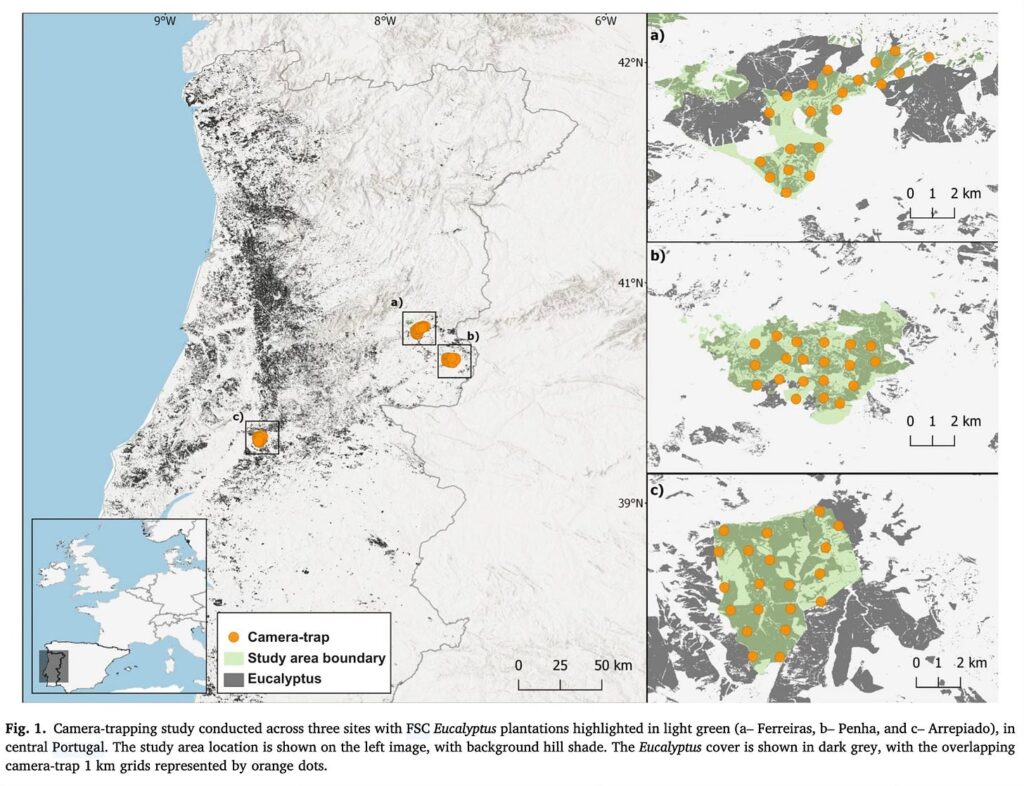
About one-fifth of the forests were harvested during the study periods, which ran from Nov. 2022 to Feb. 2023 and from May to Aug. 2023/2024.
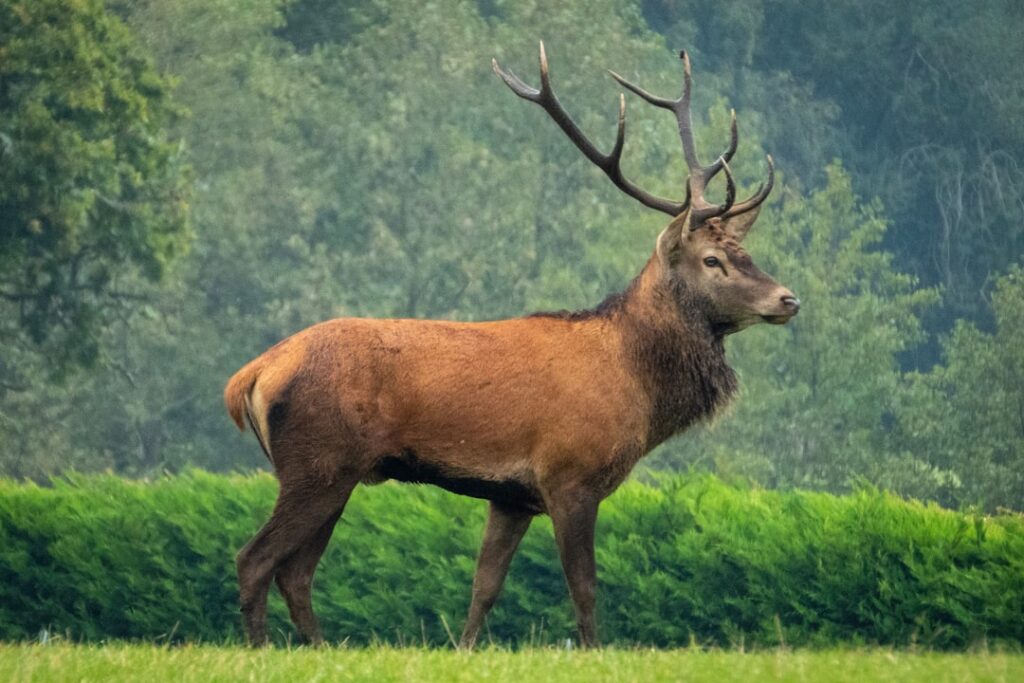
The cameras picked up 10 species of mammals – a mix of herbivores like red and roe deer, wild boars and hares, and carnivores such as badgers, martens and red foxes.
The results showed that the mammals, as expected, sought out areas with higher plant productivity and generally avoided harvested sites and areas with a lot of vegetation edges.
Different species showed different patterns – red deer, for example, seemed to avoid areas with more productive vegetation, and wild boars weren’t as picky as the other animals about the health of the vegetation.
Not all conservation zones are equal
The biggest surprise, however, was the overall lack of preference for the conservation zones.
The researchers had expected all species to show a pronounced preference for areas in or near the designated conservation zones, but only red foxes did so. The other mammals didn’t, and some of the predators were actually found in greater numbers farther away from them.
One potential reason for this, the authors guessed, could be that the conservation zones may not have been set up ideally – for example, they could have been too long and narrow to provide the animals with the home range configuration they need to thrive.
To maximize their value to animals, the authors recommend changing how conservation zones are implemented under FSC to ensure they are larger, more connected to each other and strategically placed.
That most species responded positively to healthier and denser vegetation and avoided harvested areas and vegetation edges means that the FSC safeguards appear to be working.
Is it problematic that non-native eucalyptus plantations get FSC certification at all?
Perhaps. However, the reality is that nearly one-tenth of Portugal is covered with this forest type. Arguably, FSC certification should at least maximize the benefits these forests provide to animals, although, as the authors found, the standards could be improved to provide more benefits to mammals.
I should also note that this study did not compare FSC-certified stands to non-certified ones, so it’s impossible to tell from its results whether FSC certification itself is beneficial to animals.
What’s the consensus?
A single scientific study should never be taken as the last word on any subject. So what does the consensus say?
As I alluded to earlier, opinions abound about how effective FSC is at ensuring the forests it certifies benefit local ecosystems and the human communities around them.
Some environmental advocates aren’t happy about concessions FSC is making to logging companies. Greenpeace International, one of the original founder organizations, ended its membership in 2018 due to concerns about FSC not meeting its environmental and social goals.
National Greenpeace offices in countries with stronger forest governance are continuing with the FSC, however.
Some founding and long-term supporters of FSC were concerned about the erosion of rigor within the organization and started the website FSC-Watch to investigate what they see as shoddy certification practices.
Meanwhile, some foresters say the costly environmental provisions and complex certification requirements aren’t paying off financially through higher prices.
As for scientific studies, there are surprisingly few on the effects of forest certification, and those have shown mixed results.
A 2016 meta-analysis in the Journal of the Society for Conservation Biology concluded that “certification has substantial environmental benefits, typically achieved at a cost of reduced short-term financial profit, and accompanied by some improvement to the welfare of neighboring communities.”
That study also found that “the social impacts are controversial, with both positive and negative changes reported.”
A 2024 study in the journal Nature on mammals in Africa found more large mammals in FSC-certified forests than in non-certified forests, especially elephants, primates and even-toed ungulates (a group that includes giraffes, antelopes, gazelles and hippos).
A 2019 study in the journal Ecological Indicators, however, found no significant ecological improvements in forest management between FSC and non-FSC forests in Russia.
So should you buy FSC-certified wood products?
It’s complicated.
There’s no clear consensus in the scientific or environmental communities.
Given that FSC operates in more than 80 countries and covers vast and varied types of forest – including tropical, temperate and boreal forests – it’s not surprising that there would be regional and political differences in ecosystem benefits.
Mongabay’s Hans Nicholas Jong interviewed Kim Carstensen, FSC’s director-general, in 2022, who told the outlet that “some of the complaints have a basis, and that while the FSC will never be the perfect system in everyone’s view, it’s still ‘the best that can be done’ and ‘provides the basis for a lot of opportunities to be created.’”
The Guardian’s Tom Perkins summarized the various wood certification programs available and concluded that the FSC label is the best of the green labels, and “its good far outweighs its shortcomings. You can generally trust it.”
Likewise, Sierra Club supports FSC “as the highest available standard for forest certification. FSC certified forestry goes farthest in protecting forest biodiversity, ancient old-growth forests, water quality and the well-being of workers and forest-dependent peoples.”
I think that sums things up quite well and agrees with my research. Is it perfect? No. But it’s still far better than free-for-all logging without it and better than its competitors.
For my purchases, I’ll focus on the FSC label. As for other forest certifications – I’m not convinced they provide a measurable conservation benefit.
If you’d like to get new posts sent directly to your inbox every week, subscribe to my newsletter via Substack:
It’s free to subscribe, but if you choose the paid option you’d support my work and help keep my articles free for those who can’t afford a paid subscription!
Not ready to subscribe? It takes many hours to research and write each post, so please consider supporting my work by buying me a coffee (or a beer…😄).
Links to resources:
- Forest Stewardship Council (FSC)
- FSC: Monitoring FSC’s reach
- Sierra Club: Forest certification and green building
- The Guardian, 11/1/2025: Can wood be good? Green forestry standards demystified, from SFC to SFI
- European Data Journalism Network: Portugal: wildfires and the eucalyptus curse
- FSC – Watch
- Matias et al., 2025: Mammalian response to FSC forest certification in production plantations. Forest Ecology and Management, 601:123360.
- George, Kizha and Daigneault, 2022: Is forest certification working on the ground? Forest managers’ perspectives from the northeast U.S. Trees, Forests and People, 7: 100197.
- Burivalova et al., 2016: A critical comparison of conventional, certified, and community management of tropical forests for timber in terms of environmental, economic, and social variables. Conservation Letters, 10: 4-14.
- Zwerts et al., 2024: FSC-certified forest management benefits large mammals compared to non-FSC. Nature, 628: 563-568.
- Blumroeder et al., 2019: Ecological effects of clearcutting practices in a boreal forest (Arkhangelsk Region, Russian Federation) both with and without FSC certification. Ecological Indicators, 106: 105461.
- Tysiachniouk and Vorbrugg, 2025: The transformation of the Forest Stewardship Council (FSC) certification scheme in Russia after the full-scale invasion of Ukraine. Forest Policy and Economics, 178: 103559.